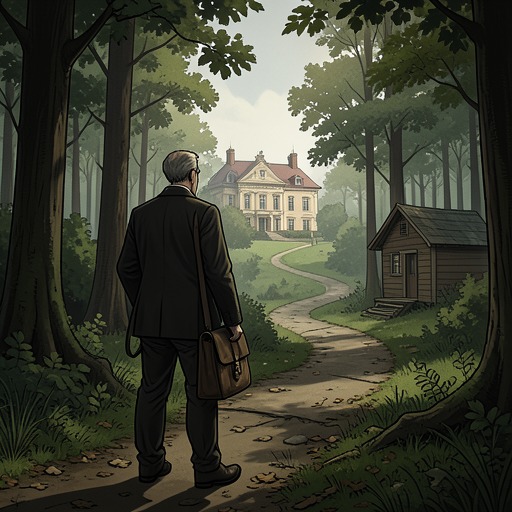
Chestnut tree at Mariabronn
Narcissus and GoldmundThe Chestnut tree at Mariabronn is a foreign sweet chestnut beside the entrance to Mariabronn Cloister, rooted in the novel’s landscape of departure and return. Its recurring presence links the institution’s passing generations with Goldmund’s first arrival and later farewell: at first it is a beautiful, unfamiliar tree; eventually it becomes one of the places he carries away as a fading picture in his heart.
Description and Place in the Cloister
The tree stands close to the road outside the cloister entrance, beneath a rounded arch resting on slim double columns. A monk brought it from Italy after a pilgrimage to Rome many years before the story begins. Its sturdy trunk and full crown make it conspicuous among the local trees, and its appearance echoes the slender sandstone columns and carved stone ornaments of the cloister. The text describes it as a foreign presence, loved by people from the south but regarded as an outsider by the natives.
Its yearly cycle makes it a familiar measure of time at the entrance. It waits until the surrounding trees have turned green before putting out its own leaves; around the shortest nights of the year, pale blossoms appear among the foliage. In October, after the grape and apple harvests, the wind shakes chestnuts from its golden crown. Cloister students scramble for the nuts, while Prior Gregory, himself from the south, roasts them in his room’s fireplace. The tree is thus not merely a landmark: its seasons are woven into the everyday life of the school.
A Witness to Generations
The boys who pass beneath the tree change as the years go by. Some become novices and monks, grow old, and die within the cloister; others leave after their studies for castles, merchants’ homes, or artisans’ houses, later returning as adults with sons of their own. The tree remains at the threshold while those who pass it move through distinct lives and generations. Its long presence makes visible the cloister’s continuity without suggesting that its occupants remain unchanged.
That continuity belongs to a place full of varied activity. Teaching, learning, administration, religious practice, and different kinds of study pass from one generation to the next. The tree stands outside this busy institution, marking the entrance to a world in which people may stay for life or depart into the wider world. Its rootedness provides a quiet counterpoint to the movement of students and visitors.
Goldmund’s Arrival
When Goldmund arrives as an adolescent in spring, the chestnut is still bare after winter. He and his father tether their horses beneath it, and Goldmund pauses to ask what kind of tree it is. The father, whose attention is directed elsewhere, does not answer; the porter tells Goldmund its name. Goldmund responds with a friendly introduction and takes confidence from this first encounter with the unfamiliar place.
The moment establishes the tree as part of Goldmund’s personal entry into the cloister. Before he has met his teachers or settled into the students’ dormitory, he has noticed the tree and spoken with the porter. He feels that he has already encountered two possible friends in his new surroundings. The tree’s strangeness is therefore welcoming rather than threatening: it gives the new arrival something beautiful to recognize even as he begins life in a place he does not yet know.
Departure and Memory
Years later, when Narcissus’s withdrawal makes the cloister’s life seem to Goldmund increasingly distant, he visits the places that have mattered to him before leaving. He stands before the chapel’s Madonna, the portal’s apostles, the carved choir stalls, the garden fountain, and a column bearing three animal heads; he also leans against the courtyard lindens and the chestnut tree. The tree has become one landmark among the places through which he understands his life at Mariabronn, but his farewell is not simply to buildings. Even while he remains among them, they are beginning to lose their immediacy and change into remembered images.
This change brings the tree’s two narrative functions together. At Goldmund’s arrival, its unfamiliar beauty helps him feel at home; at his departure, its familiar presence is already becoming part of what he must leave behind. The generations who pass beneath it embody the same pattern on a broader scale: some remain, others go, and the place persists as the setting from which their lives diverge.
Significance
The tree gives physical form to the novel’s contrast between rooted order and a life of movement. It stands at the threshold of the cloister, an imported presence that has become part of its surroundings, while generations of students pass beneath it and Goldmund eventually departs. Its foreignness also connects his first response to the cloister with his later attention to objects and forms: he notices the tree before he knows the world around it, and the sight becomes a small, durable part of his recollection.
Unlike the people who grow old, leave, or return, the chestnut remains a recurring point of recognition. Yet it is not outside time: its leaves, blossoms, and harvest mark the seasons, and even Goldmund’s memories of it begin to fade as he prepares to go. The tree’s significance rests in that double movement—continuity in the landscape, change in the lives and perceptions gathered around it.